
Still brushing manually? You might be missing out. A recent clinical trial explores how switching to an electric toothbrush impacts plaque and gingivitis in just four weeks.
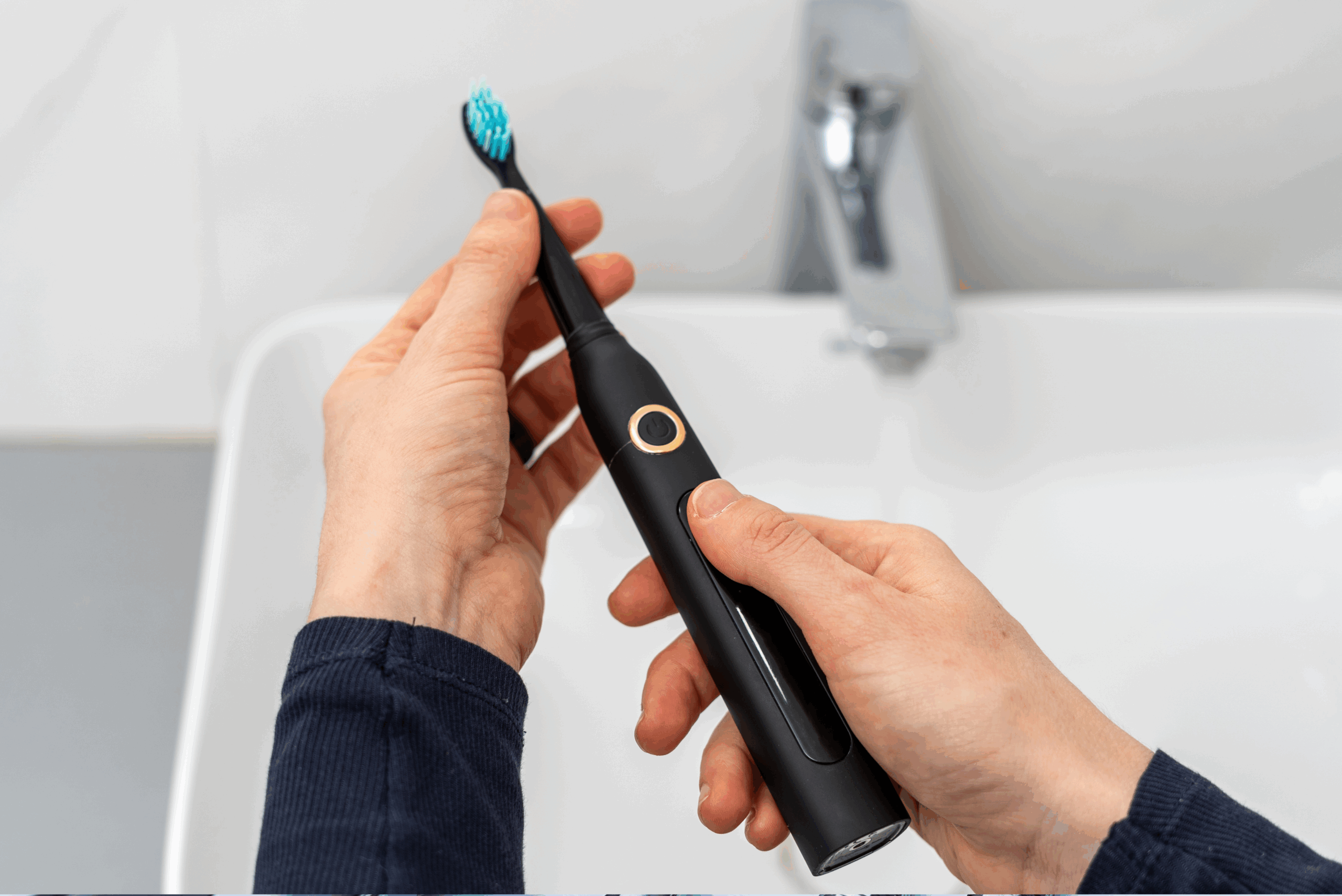
Despite the widespread availability of electric toothbrushes and strong evidence supporting their benefits, many people with gingivitis still rely on manual brushes. To address this, a study published in the Journal of the American Dental Association (JADA) evaluated a new oscillating-rotating electric toothbrush designed specifically for manual toothbrush users, focusing on its effects on plaque and gingivitis.
Our expert, Dr. Jamal, summarises the study below, and answers the question “Are electric toothbrushes better?”
Our Summary
In this clinical trial, 90 adults with plaque-induced gingivitis who regularly used manual toothbrushes were randomly assigned to one of three groups: a manual toothbrush, an oscillating-rotating electric toothbrush in “sensitive” mode, or the same electric toothbrush in “daily clean” mode.
Participants were instructed to brush twice daily using their assigned toothbrush and standard toothpaste. The electric toothbrush users followed the manufacturer’s instructions, while manual users continued their usual technique. The first brushing session was supervised to ensure proper use.
A blinded examiner recorded the gingival and plaque outcomes such as the gingival index, plaque index and number of bleeding sites at baseline, week 1, and week 4. All 90 participants completed the study, and no adverse events were reported.
Findings
Although all groups showed improvement, the oscillating-rotating electric toothbrush, regardless of mode, was significantly more effective than the manual brush in reducing plaque and gingivitis.
At week 4, the oscillating-rotating electric toothbrush’s “daily clean mode” delivered the greatest benefit, with bleeding sites decreasing by an average of 15, compared to just 6 in the manual brush group. Likewise, whole-mouth plaque scores improved more in both electric toothbrush groups than in the manual group.
Perhaps most clinically meaningful was the shift to gingival health, defined as fewer than 10% bleeding sites. By the end of the study, only 20% of manual brush users reached this threshold, compared to 47% of participants using the oscillating-rotating electric toothbrush in sensitive mode and 60% using the daily clean mode. The odds of achieving healthy gingiva were six times greater with the oscillating-rotating electric toothbrush in daily clean mode than with a manual brush.
Conclusion: Are Electric Toothbrushes Better?
In a nutshell, yes!
This study reinforces the clinical superiority of electric toothbrushes, particularly the oscillating-rotating type, over manual brushes in managing gingivitis.
The study concluded that for manual brush users, switching to a user-friendly electric toothbrush option can lead to meaningful oral health improvements in just four weeks. This makes it a simple and effective step toward better gingival health.
About Dr. Jamal

Dr. Jamal Giri is an orthodontist and associate professor at B.P. Koirala Institute of Health Sciences in Nepal. He obtained his orthodontic training from the Institute of Medicine, Tribhuvan University, Nepal, in 2014.
Currently pursuing a PhD at the University of Adelaide, Dr. Jamal’s research focuses on the genetic and environmental factors influencing malocclusion development. He also holds a postgraduate certificate in clinical education from the University of Edinburgh and a master’s in medical education from the University of Nottingham.
Dr. Jamal teaches on the Diploma in Orthodontics and Dentofacial Orthopaedics at the London Dental Institute.
Read More
Adam R, Grender J, Timm H, Goyal CR, Qaqish J. A 4-week randomized clinical trial evaluating plaque and gingivitis effects of a new oscillating-rotating electric toothbrush. The Journal of the American Dental Association. 2025 Jun 18.
Get Our Research Round-Ups in Your Inbox
Each month, we publish bite-sized summaries of critical research to keep you updated with the latest advancements in dental science.
Subscribe below to stay ahead in your practice and enhance your knowledge with concise and informative summaries, delivered straight to your inbox.
